Stone Sour
Countless groups have come and gone without making a dent. Usually, the most talented or driven members join other groups. Others drift into day jobs and real lives. Rarely does an unsuccessful group revive itself and finally achieve success.
With a few twists and turns, that’s the Stone Sour story.
Though it might be tempting to classify Stone Sour as a Slipknot side project, fact is, Stone Sour, the name taken from a whiskey and orange juice concoction, was around first.
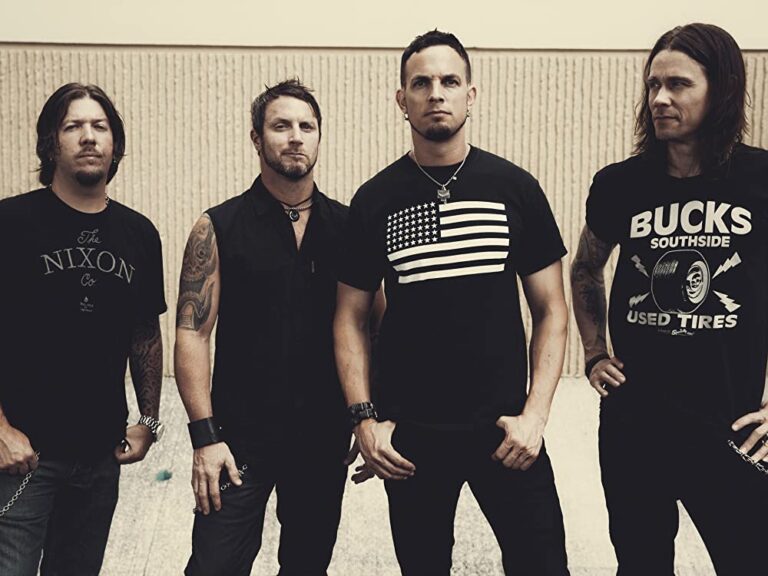
The Des Moines based group formed in ’92. But after five years of club gigs and a failure to dial in anything that worked on a large scale, vocalist Corey Taylor left for Slipknot. He was followed, in short order, by guitarist Jim Root. Stone Sour bassist Sean Economaki became Slipknot’s stage manager.
In ’00, guitarist Josh Rand, who’d been in Stone Sour for a time, approached Taylor with a number of songs. That led to a year and a half long songwriting collaboration. Taylor and Root then advanced the notion of re-forming Stone Sour. Economaki and original drummer Joel Ekman were recruited along with DJ Sid Wilson.
The first order of business was a song for the “Spider Man” soundtrack (“Bother”) which was originally credited as a Taylor solo effort. The group’s self-titled debut dropped later in ’02.
Sour Sour’s sophomore effort, “Come What(ever) May,” hit in August of ’06. In
interviews, Taylor was very enthusiastic (that should be expected) about the album.
“It’s good, heavy Rock that’s going to kick you in the face.” He also said that the set was superior to its predecessor. “The songs are better, the performance is better, the production is better. It shows what a second album should be.”
Ekman left the band in ’06 to take care of his cancer-stricken son. Roy Mayorga was selected as his replacement though Godsmack’s Shannon Larkin played drums on the set’s opening track “30/30-150.”
From “Come What(ever) May” the single “Through Glass” topped the Billboard Mainstream Rock chart while “Sillyworld” peaked at #2 on the same chart. Two other singles, “Made Of Scars” and “Zzyzx” stalled in the 20’s.
Through Glass
Sillyworld
The band’s third album, “Audio Secrecy” was recorded in Nashville with producer Nick Raskulinecz, who was the producer for the band’s previous album. The ’10 set held “Say You’ll Haunt Me,” which topped Billboard’s Rock Songs chart.
Say You’ll Haunt Me
As ‘12 was getting underway, Taylor talked about the group’s fourth album – already in progress. “Our ultimate goal is a double concept album, which the only way I can describe it is (Pink Floyd’s) ‘The Wall’ meets (Alice In Chains’) ‘Dirt’ on steroids.” Taylor, Rand and Root all had songs in the works.
A few months later, Taylor provided a bit more information stating the double set’s name was “House Of Gold And Bones (HoGaB).” “Each disc (has) one half of the story,” he explained via Twitter.
Stone Sour’s fourth studio effort was produced by David Bottrill (Tool, Muse, Staind) and recorded in Des Moines. “The album is a morality play about a man who’s standing at the crossroads of his life trying to figure out what to do next,” said Taylor. “I’ve had the idea for the concept for a few years actually, but I’ve never given myself the time to really flesh it out and see it clearly.”
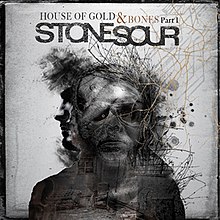
House Of Gold And Bones
With “House Of Gold And Bones (Part 1)” about to be released, Stone Sour announced via their Facebook page that bassist Johny Chow had replaced Economaki. “Johny is a fantastic player and a long-time friend,” said Rand. “We are all excited to have him part of what will be our most exciting and ambitious album cycle yet.” The bass tracks for “Part 1” were recorded by Skid Row’s Rachel Bolan.
“Part 2″ dropped in ‘13. Root was angry and depressed after being fired by Taylor that November. His departure was not confirmed until the following May. Though out of Stone Sour, Root was still in Slipknot. Later, Root said that his sacking was for the best. “I guess you could say I was given the opportunity to start the Slipknot album (“5: The Gray Chapter”), to put it nicely.”
In ‘15, the band confirmed Christan Martucci as Root’s replacement. He’d been the group’s touring guitarist. But before there was a full album with Martucci, Stone Sour had two early singles, “Bother” (from ‘02’s “Stone Sour”) and “Through Glass” (from ‘06’s “Come What[ever] May”) certified platinum in ‘17 by the RIAA (Recording Industry Association Of America).
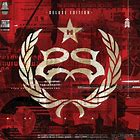
Hydrograd
Not wanting to rest on their laurels, Sour Stone followed that with the release of “Hydrograd.” It was their first album in four years though they had previously issued two EP’s: “Meanwhile In Burbank…” (’15) and “Straight Out Of Burbank…” (’15).
Before the group’s sixth album dropped Taylor said it was “probably one of the best records we have done since the first Slipknot album.”
The first album without Root debuted at #8 on the Billboard 200 and received positive reviews.
However, there was one ‘critic’ who wasn’t buying it. In an interview ostensibly to promote Nickelback’s album “Feed The Machine,” frontman Chad Kroeger called Stone Sour “Nickelback Lite” and challenged Taylor to “write a hit song.” It may have escaped Kroeger’s notice that Stone Sour’s “Song #3” was currently #1 on the Active Rock chart.
Kroeger also took a swipe at Slipknot. It was no doubt payback for Taylor’s past negative comments regarding Kroeger and Nickelback. Taylor responded by calling Kroeger an ‘idiot’. Then he went on to say that Nickelback was to Rock what KFC was to chicken.
Incorporating Heavy Metal, Punk and Hard Rock elements, “Hydrograd” was recorded in North Hollywood, with producer Jay Ruston.
As a quasi-follow up, Stone Sour presented “Hydrograd Acoustic Sessions” (selected tracks from the album) on Record Store Day, the annual celebration of independent record stores.
In ’20, Taylor announced that Stone Sour was taking a hiatus. “I feel like Stone Sour has kinda run its course for now. We’ve put it on the shelf for now. Everyone’s kind of going and doing their own thing.”
###