
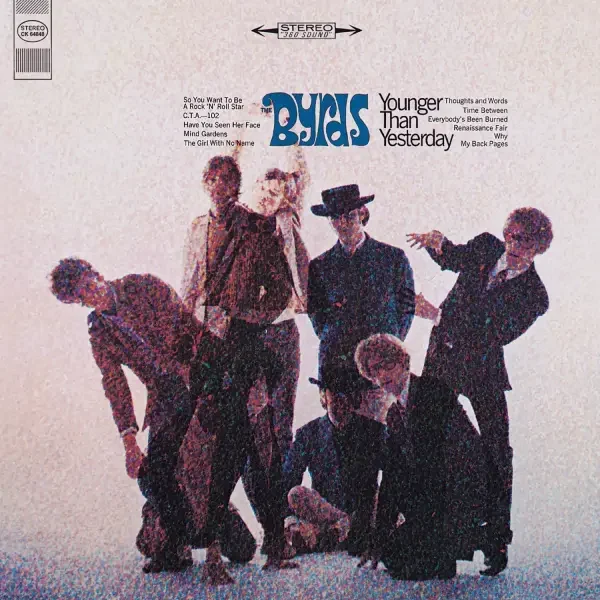
The Bryds
– Younger Than Yesterday
The album moves with a bright, curious tone that lifts every harmony and riff, giving the songs a loose elegance shaped by crisp guitars and sly rhythmic shifts. The vocals carry a calm confidence that lets odd corners and sharp turns feel natural, and the writing leans into open emotion without slipping into haze. Each track feels like a different angle on the same restless spark, pulling folk-rooted rock toward fresh shapes and unexpected colors. The record holds its center through steady grooves, warm detail, and melodies that cling to the ear long after the needle lifts.
A confident, vibrant statement built on sharp hooks, bold ideas, and a lasting glow.


Best of…
The Byrds had already established themselves as folk-rock pioneers, but Younger Than Yesterday proved they weren’t content to stick to jangly protest anthems and Dylan covers. This is the sound of a band expanding in every direction at once—dipping into jazz, psychedelia, country, and baroque pop—without losing the effortless melodicism that made them stand out in the first place. It’s a kaleidoscope of sound, where shimmering 12-string guitars meet woozy studio experimentation, all while keeping one foot planted firmly in the American songbook.
What makes this album so compelling is its tension between pop craftsmanship and restless innovation. One moment, it’s pure California sunshine, all golden harmonies and breezy melodies; the next, it’s spiraling into strange, cosmic territory, bending time and space with backwards tape loops and surreal lyrics. And yet, it never feels like a mess—the hooks are sharp, the performances crisp, and the production daring but never self-indulgent. This is the moment where The Byrds proved they weren’t just folk-rock figureheads, but sonic explorers charting new territory for rock music.
Decades later, Younger Than Yesterday still feels fresh. It’s a bridge between past and future, between traditional songcraft and studio wizardry, between American roots music and the limitless possibilities of psychedelia. You can hear its influence in everything from country rock to indie pop, yet it remains singular—a snapshot of a band at their most adventurous, still riding high before the inevitable turbulence that would send them in different directions.
Choice Tracks
So You Want to Be a Rock ’n’ Roll Star
A clipped beat and tight bass figure set up a brisk drive that lifts the vocal’s sly tone. The horn accents widen the frame with a pointed flair. The track stands out for its sharp rhythm and its wry look at ambition wrapped in a bright, bustling arrangement.
My Back Pages
A gentle acoustic pulse guides the melody while the vocal bends each line with patient reflection. The harmonies settle in with soft weight, deepening the emotional pull. The track shines through its steady pacing and the quiet insistence in every phrase.
Renaissance Fair
A spiraling guitar line opens into a lively sway that gives the song a playful tilt. The vocal rides the motion with light phrasing that builds a colorful mood. Each shift in rhythm adds spark, creating a vivid flash of energy inside the album’s calmer spaces.
Have You Seen Her Face
A tight groove and chiming guitars create a quick sense of motion, and the vocal leans into that pace with smooth confidence. The hook lands cleanly and shapes the track’s forward push. Its blend of clarity and drive makes it one of the album’s brightest moments.
The Byrds craft a set of songs shaped by warm harmonies, sharp guitars, and ideas that push folk-rooted rock into vivid new territory. The album moves with steady confidence, giving each track a distinct color while keeping a clear emotional through-line.
Younger Than Yesterday is where folk-rock hits a fork in the road and takes both paths: one leading straight into the cosmos, the other deeper into the American underbelly. “So You Want to Be a Rock ‘n’ Roll Star” kicks things off with a sneer, McGuinn and Hillman laying down a riff that sounds more like a warning than an invitation. Add in that South American-flavored trumpet break, and you’ve got a song that mocks the music industry while making you want to dance right into it. Then “Have You Seen Her Face” follows, a jangly rush of adrenaline that proves Chris Hillman wasn’t just a bass player—he had the songwriting chops to keep up with anyone in the band.
“CTA-102” is where things start getting weird. Sci-fi bleeps and bloops, robotic voices, and McGuinn fully leaning into his space-obsessed instincts. It’s playful, ridiculous, and somehow still works. Then there’s “Renaissance Fair,” a two-minute daydream where David Crosby and McGuinn’s harmonies stretch out like sunbeams through stained glass. But the real gut-punch arrives with “Everybody’s Been Burned”—Crosby at his most haunted, whispering over jazz-inflected chords like he’s standing at the edge of something he doesn’t want to fall into. It’s one of the most achingly beautiful things they ever recorded, all smoke and regret.
“My Back Pages” takes Dylan’s scathing self-reflection and turns it into a swirling, bittersweet anthem, proving that irony always sounds better when sung in perfect harmony. And then there’s “Why”—a proto-psychedelic raga-rock burner that basically invents half of what Jefferson Airplane and every other West Coast band would spend the next few years chasing. By the time “Thoughts and Words” and “Mind Gardens” drift into the ether, you realize Younger Than Yesterday is more than just an album. It’s a turning point, a record that caught The Byrds right as they were shedding their folk-rock feathers and taking flight into something far stranger.