
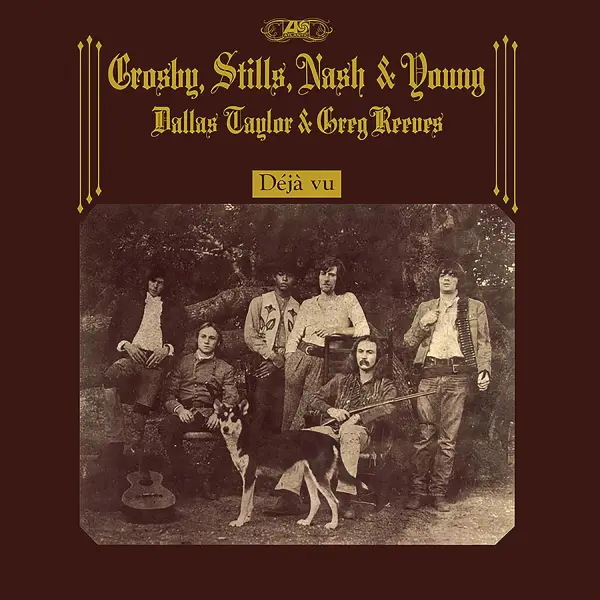
Crosby, Stills, Nash & Young
– Déjà Vu
A collaborative peak shaped as much by friction as by fellowship, still resonant decades on.
Déjà Vu captures a brief moment when four strong voices learned how to lean into one another without sanding off their edges. The record moves with an uneasy grace, balancing communal warmth against personal fracture. Harmonies glide in like shared breath, but the songs never settle into comfort; tension hums beneath the surface, giving the album its lasting pull.


Best of…
What makes this record endure isn’t polish or perfection—it’s the sound of collaboration under strain. Acoustic textures dominate, yet there’s grit in the grain of the performances. The writing turns inward and outward at once, tracing love, politics, doubt, and distance without trying to resolve them neatly. Every track feels lived-in, as if the tape itself absorbed the arguments, reconciliations, and late-night second thoughts.
Sequencing plays a quiet but crucial role. The album drifts between intimacy and confrontation, never staying in one emotional register for long. Moments of calm are followed by unease, optimism shadowed by fatigue. Déjà Vu doesn’t mythologize its era so much as document it, letting beauty and fracture coexist without commentary.
Choice Tracks
Carry On
A restless opening that sets the album’s emotional weather. Shifting sections and layered vocals suggest motion without certainty, capturing the sense of forward movement driven more by necessity than confidence.
Teach Your Children
Gentle on the surface, but firm in its intent. The song frames responsibility as something passed hand to hand, using warmth as persuasion rather than sermonizing.
Woodstock
Urgent and unsettled, this track transforms an idealized moment into something more reflective and uneasy. The arrangement pulses with anticipation and doubt, suggesting that belief and anxiety often arrive together.
Our House
Brief, domestic, and deceptively light. Its charm lies in its simplicity, offering a moment of everyday calm that feels fragile precisely because it’s so fleeting.
Déjà Vu endures because it refuses to smooth over conflict. Its harmonies invite, but its songwriting questions. The album stands as a record of connection formed under pressure, where unity is real, temporary, and deeply human.
Crosby, Stills, Nash & Young’s Déjà Vu perfectly captures the spirit of the early 1970’s while showcasing the unparalleled chemistry of four extraordinary talents. This record blends folk, rock, and country influences into a seamless tapestry of sound. Each member’s distinctive musical voice shines through, yet the album’s unity lies in its intricate harmonies, evocative lyrics, and timeless melodies.
What makes Déjà Vu truly great is its emotional resonance and thematic depth. The songs navigate personal introspection, political unrest, and the search for connection with poetic elegance. The production is both warm and vibrant, allowing the acoustic textures and electric flourishes to coexist harmoniously. Its layered arrangements and impeccable vocal harmonies create a rich, immersive listening experience that feels both intimate and expansive.
Déjà Vu remains a cultural touchstone, not only for its artistry but also for the way it reflects the hopes and struggles of its time. Decades later, it stands as a timeless reminder of the power of collaboration and the enduring beauty of heartfelt, thoughtful songwriting.