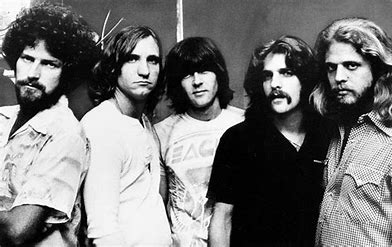
The Eagles
After paying dues in several unsuccessful bands, Don Henley and Glenn Frey were asked to be part of Linda Ronstadt’s backing band for an upcoming tour.
Also, on board were Flying Burrito Brothers guitarist Bernie Leadon and bassist Randy Meisner, who had been a member of Rick Nelson’s Stone Canyon Band. Along the way musician and future producer John Boylan suggested the four start a group.
A meeting between Frey (with the other Eagles present) and David Geffen (future entertainment mogul) at a house Frey was sharing with Jackson Browne, convinced Geffen to sign the band to his Asylum Records.
“Take It Easy” released in May of ’72 was the first single from the self-titled debut album. It was a great little Rock song with a touch of Country (there was a banjo in there)
Co-written by Browne and Frey, it had already been released on a Browne album. But for The Eagles it was a perfect and successful introduction peaking at #12 on the Billboard Hot 100 eventually becoming one of the band’s signature songs.
With a haunting sound, the slower yet dense “Witchy Woman” did even better. On the other hand, “Peaceful Easy Feeling” had a light, open and airy feeling. It was not real exciting but perfect for the laid-back times. All in all, not a bad debut. The sound got tagged as Country/Rock, a term neither Henley nor Frey appreciated.
Rolling out ten months later “Desperado” was a mellower effort. “Tequila Sunrise” was a
hit ballad. Also, there was the “Doolin’ Daltons” song cycle. Over the long haul the song
that had the most impact was the ballad title track. Though never released as a single it garnered major radio airplay and was covered by several artists including Ronstadt.
“On The Border,” hit the stores in ’74 and was the early Eagles’ most Rock-oriented album. “Already Gone” scored with scorching guitars while “James Dean” was the ultimate tribute to the fallen actor (“too fast to live, too young to die”).
Already Gone
James Dean
Both songs had a driving rhythm and well-oiled chord changes. Also, some
hot guitar solos. For the “Good Day In Hell” session slide guitarist Don Felder was hired. His playing so impressed the band he was asked to join.
“One Of These Nights” was a good album on its own merit but it was apparent the band was recycling. “Lyin’ Eyes” was practically interchangeable with “Peaceful Easy Feeling.” Same thing with “One Of These Nights” and “Witchy Woman.” And so on.
“Eagles Greatest Hits” (eventually referred to as “Volume I”) was released and did good business. However, no one imagined it would do what it has done.
A fundamental change was at hand. Bernie Leadon departed. His replacement, Joe Walsh, had been the driving force behind the James Gang and had something of a solo career going. He also shared the same management as The Eagles.
With a harder, darker edge, “Hotel California” was a landmark album. The title track, a brooding, spooky guitar song building toward a fatalistic end (“you can check out any time you want, but you can never leave”), became the most recognizable song in the group’s repertoire. Also, “Life In The Fast Lane” was a classic ‘drug fueled” L.A. story.
Meisner called it quits after a European tour sighting exhaustion and was replaced by Timothy B. Schmit. The Eagles rolled out “The Long Run” album containing the title track, “Heartache Tonight” and the ballad “I Can’t Tell You Why,” with Schmit on lead vocals (he also co-wrote the song). All three were major hits.
Life In The Fast Lane
I Can’t Tell You Why
As the ’80s arrived the Eagles were inactive. Each member, and even former members, were busy with solo projects. There was talk of a reunion but Henley said it would only happen when “Hell freezes over.” Hell didn’t but The Eagles thawed.
The “Hell Freezes Over” album (and tour) produced a couple of ballads that did well at adult radio stations.
In ’98, the Eagles were inducted into the Rock and Roll Hall of Fame. All seven past and present members appeared together. They played “Take It Easy” and “Hotel California.” The following year “The Eagles Greatest Hits Volume I” inched out Michael Jackson’s “Thriller” to become the all-time best-selling album in the U.S.
Being in The Eagles was not for the fate hearted. Felder left the group in ’01. That was followed by a suit claiming he was treated unfairly and deserved a larger portion of the group’s royalties. Henley and Frey counter-sued citing breach of contract. Then to amp it up a little more, Felder announced that he’d written a tell-all bio about his tenure in the band. The book was shelved (for the time being) and the suits were settled out of court.
When everything calmed down, The Eagles, now a quartet (Henley, Frey, Walsh and Schmit), issued “The Very Best Of The Eagles,” the ’03 compilation was the group’s first to cover their entire career.
Four years down the road, a lot of noise was made about “Long Road Out Of Eden.” It was the Eagles first complete studio album since ’79 (“Hell Freezes Over” doesn’t count because it had live tracks).
“Long Road Out Of Eden” was sold exclusively at Wal-Mart and online at Musictoday.com. The Wal-Mart connection raised eyebrows. Perhaps The Eagles were no longer desperados. The single “How Long,” written by J.D. Souther, managed to land on the County chart. That really wasn’t much of a stretch. Early in their career The Eagles were more Country than most of the stuff rolling out of Nashville (“Lyin’ Eyes” hit the Country chart in ’75). Besides, countless Country performers lifted liberally from The Eagles catalog.
Surprisingly, ’12 was a busy, and unique, year. The Eagles performed their first concert in South Africa for more than 60,000 fans at Cape Town Stadium. Then it was off to their first ever Middle-East concert at The Sevens Stadium in Dubai.
Returning to the U.S., Berklee College of Music President Roger Brown presented the group with honorary Doctor of Music degrees at school’s commencement ceremony in Boston. The band was recognized for their achievements and influence in music, and for their enduring contributions to American and international culture.
###